
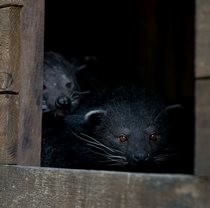
Not so long ago, in Feldman Ecopark appeared an enclosure where dwarfish (or barking) mutjac deer and binturongs, named bear cats for appearance and clumsy gait live together. Both species are from Southeast Asia, quite peacefully coexist in the nature and, according to the specialists of the Social and Humanitarian Multi-Complex, perfectly complement one another in an exposition.
“Five binturongs and a couple of muntjacs live in the spacious shady enclosure. The former occupy the lower tier and are active during the day period, while the latter settled on the second tier and leave their lodges only in morning and evening hours. They have no competition for food: deer prefer hay, grain and vegetables, while binturongs eat exotic fruit, quail eggs and honey as delicacy — the zoologists of Feldman Ecopark told. – We often use mixed expositions – it is both enrichment of the environment of animal welfare, and a sight for visitors. Ecopark’s concept ideally provides such zoogeographical locations corresponding to natural biotopes therefore we plan to build enclosures with surprising neighbors further”.
It should be noted that muntjac is rather small deer, making the sounds similar to dog bark in a state of fuss or excitement. Males of this species have protruding teeth in the upper jaw similar to canines, and a long tongue reaches ears. A binturong –is the animal bearing a faint resemblance to a cat and a marten from the Viverridae family. By means of a tenacious tail the animal dexterously climbs trees, while on the ground binturong waddles clumsily like a bear. Though binturongs relate to predators, their diet consists of vegetable food with insects and eggs of birds as proteinaceous additive.
It should be reminded that the animal collection of Feldman Ecopark comprises 2,000 animals of more than 300 species.


