
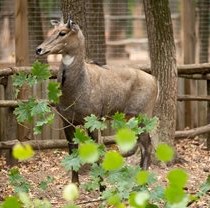
The male and female Indian antelope nilgai recently moved to Feldman Ecopark from Odessa Zoo. They were traded for two adult African spurred tortoises within the cooperation programme aimed at the preservation of rare species. According to specialists of the Multi-Complex, animals feel fine after transportation and already settled in a new spacious enclosure after a short quarantine. They will live there all year round. Besides, they will be able to hide in a cozy heated appartments from frost and bad weather.
“Animals are contact and very curious – actively adapt to a new place, sniff everything, try to make friends with neighbors. These are young individuals – male is a year and a half, female is one year old. We hope that in the nearest future they will have addition, – the head of the Ungulates department of Feldman Ecopark Serhii Popov told. – We feed them twice a day – in the morning and in the evening. Nilgai eat hay, root vegetables and grain. Besides, they especially like brooms from fresh oak and maple branches.”
It should be noted that nilgai are quite large antelopes. They are 2m high and weigh 200 kg. Originally from the Indostan Peninsula, they are also called “large Indian antelope”. Males have small horns compared to other antelopes. That’s the feature of these ungulates. Nilgai are similar to zebu cows, and their name from Hindi is translated as “blue bull”. For this reason, Hindus consider them sacred and do not eat. This is a least concern (LC) species, however, recently, its number has sharply declined due to human economic activity.
It should be reminded that the animal collection Feldman Ecopark comprises about 40 species of ungulates, the most miniature among them are muntjac deers, while the largest are bisons and camels. In total, more than 2,000 animals of 300 species live in the Social and Humanitarian Multi-Complex, including Red List species.


