
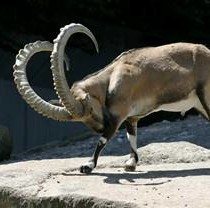
The small herd of Siberian ibexes (6 females and 2 males) settled in Feldman Ecopark recently. They arrived within the programme of cooperation under the European Association of Zoos and Aquaria (EAZA).
“These artiodactyles need protection therefore for their preservation with the subsequent possible reintroduction the species is exchanged throughout the continent” — the Feldman Ecopark’s specialists told and emphasized that the Siberian ibexes are hardly the first animals brought from the EU. We already have animals from Riga National Zoo, Skansen (Sweden), Dvur Kralove (Czech Republic), Szeged Zoo (Hungary). In total, we have already several tens; the most popular “European” is Dalma (a tapir).
“Animals-immigrants adapt to our east Ukrainian conditions well, the Siberian ibex is not an exception. Now they stay in open enclosures together with their relatives – markhors. Taking into account the behavioral particularities of these mountain inhabitants, we plan to establish artificial rocks for environmental enrichment. Animals have regular veterinary inspection, enjoy hay, branches of trees, vegetables and grain mixes”, – the specialists of the hoofed animals department Feldman Ecopark told.
It should be noted that the Siberian (stone) ibex or Asiatic ibex (tack), as it is still called in Central Asia, is the largest representative of the species, preferring to live at the height from 2,5 to 5,000 meters above sea level. Males considerably bigger than the females and possess huge curved horns. This “enviable” trophy is the reason of hunting tourism and poaching. The quantity of the Siberian ibexes is reduced every year though still the species hasn’t changed the security status from green to red according to the international classification.
It should be reminded that the Feldman Ecopark’s zoocollection comprises about 200 hoofed animals of 30 species. In total, we have more than 2000 animals including representatives of the red-listed species. Among other things, the charitable campaign “The Art of Mercy” is carried out to improve living conditions of animals and to develop animal protection programmes of the Global Public Foundation for Species Rehabilitation and Reintroduction.


