
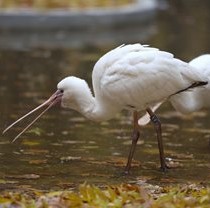
Another significant addition to the animal collection of the Social and Humanitarian Multi-Complex Feldman Ecopark arrived last week. Within the framework of the joint animal exchange programme with Riga Zoo, common marmosets and patas monkeys, as well as an alpaca and a Eurasian spoonbill found their new home in Kharkiv.
Feldman Ecopark’s deputy director of zootechnics Valeriia Ivashchenko told that the animals arrived from Riga Zoo, which Feldman Ecopark closely cooperates with for several years within the Cooperation Programme for Rare Species Preservation. “The new animals, the natural habitat of which is in different parts of the world, had a long journey from one of the Baltic states. But they coped with this challenge, and feel themselves fine at the new place. Now the animals are in quarantine,” Valeriia Ivashchenko tells.
As patas monkeys and common marmosets are the heat-loving animals, while the summer has already ended in our country, it will be possible to look at them in the company of their congeners next year, when the constantly warm weather comes.
The homeland of common marmosets is the rainforests of Brazil, where they live in families of 9-15 animals. They usually run across tree branches in search of food – fruits, tree sap, mushrooms or insects. The patas monkeys (or hussar monkeys) originate from savannahs and dry woodlands of Central Africa. They are considered the fastest runners among primates, as they can develop the speed over 50 kmh.
Eurasian spoonbill, the representative of the ibis family, is a wading bird, which may be often found in Southern and Western Europe, as well as in North Africa and some regions of Asia. Resembling a stork, a spoonbill has a white colouration of feathers, black legs and long flat and dark bill.
Alpacas are the domestic animals bred on the slopes of high mountains of South America for already 6,000 years. They have a unique, very soft and thick fur, which is highly valued for the qualities of fabric made of it.
It should be reminded that one of Ukraine’s biggest animal collections of Feldman Ecopark consists of more than 2,000 animals of 300 species, including the Red List ones.


