
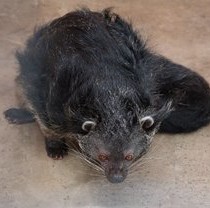
One of the most unusual mammals of the Old World, a binturong lives in Feldman Ecopark. He (to be exact she, it’s a female) settled here this summer, having moved from a small private zoo.
“A new settler was under quarantine for a long period of time. Nevertheless not many people managed to see this animal in the expository enclosure. The reason is a secretive behavior pattern of a binturong – in the afternoon, the animal chooses the darkest corners completely masking him, the activity shows only at night, when there is no visitors. Then he goes hunting for the favorite delicacy, sweet bananas. With the onset of cold weather, a binturong will be moved to “winter quarters”, like other thermophilic animals” — in Feldman Ecopark told.
It should be noted that binturongs are rather rare residents of the Ukrainian zoos where they began to appear only in the last 2-3 years. These medium-sized predators of Viverridae Family are often called “feline bears” or “bearcats” due to features of body structure and way of moving. These are small clumsy and short-legged animals with black fur, white moustaches and clusters. The passion to sweets adds him similarity to distant clumsy relatives – binturongs like ripe tropical fruit. In nature, in the jungle of Southeast Asia, vegetable food makes up the most part of their diet though they don’t disdain insects, reptiles and small birds whose nests they often ruin. Bearcats live on trees; a long, prehensile tail helps them to climb. A binturong leads mainly night way of life. In some places people tame binturongs, but they fail to become family animals because of a pungent smell. Thanks to rather wide habitat, these animals don’t belong to the category of endangered species though locals hunt them because of the meat which is considered as a delicacy and certain parts of the body are used in traditional medicine.
We will remind that the animal collection of Feldman Ecopark comprises about 2,000 animals of 300 species.


